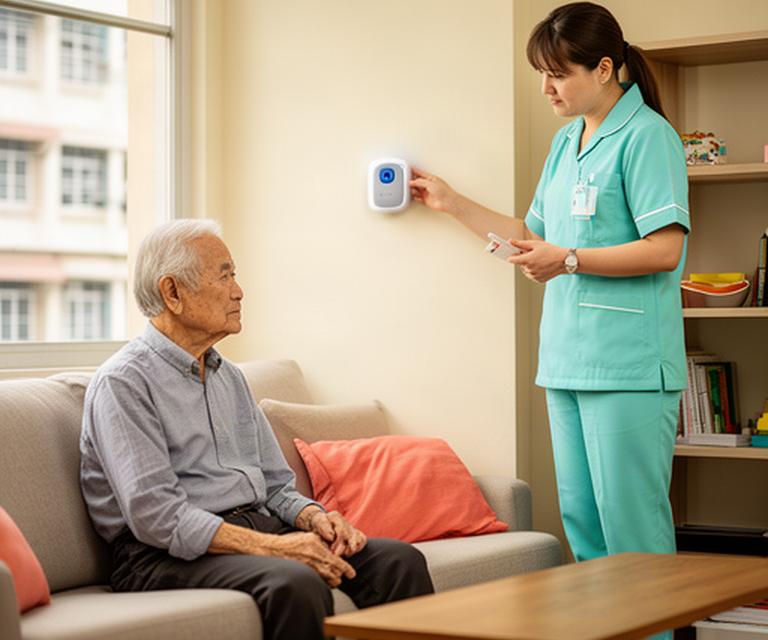
A hospital discharge can leave a family with one urgent question: who will know if Mum or Dad falls at home? Radiant Robotics plans layered HDB fall monitoring around the senior's home, comfort and care contacts.
Automatic room detection can be paired with a button the senior can press. If an alert goes unacknowledged, the agreed contact sequence moves to the next caregiver.
A sensor can miss an event. A person may not be able to reach a button. Each layer has a defined role and a clear limit.
Radar fall detection
Room sensors can identify certain fall patterns in agreed living and sleeping areas without asking the senior to wear a device.
Coverage and limits
Covers: configured room zones and supported fall patterns. Doesn't cover: every fall, every room or events outside sensor range.
Manual alert button
A wearable or wall-mounted button gives the senior a direct way to request help when they can press it.
Coverage and limits
Covers: an intentional alert when the button is within reach and working. Doesn't cover: situations where the senior cannot activate it.
Prolonged inactivity
A configured quiet period can prompt a check when expected movement has not been detected at home.
Coverage and limits
Covers: a follow-up when movement remains below the agreed baseline. Doesn't cover: the cause of inactivity or a medical assessment.
Bed and night movement
Bed-exit and night-time sensing can help caregivers check on movement patterns where night-time wandering is a concern.
Coverage and limits
Covers: agreed bed-exit or movement events. Doesn't cover: continuous supervision or every change in a person's condition.
Sensor placement, notification settings and alert thresholds are reviewed with the household before activation.
Kitchen and utility safety
Beyond falls: smoke, gas and water safety
A fall isn't the only reason a caregiver may need to check in. Add suitable sensors around an older kitchen, sink or appliance, then decide who receives each alert.
Every HDB flat is different. Sensor choices depend on the home, existing appliances and the risks the family wants to address.
Example alert points
Set for the home
Smoke and heat
A compatible detector can alert household contacts when smoke or heat reaches its trigger level.
Kitchen gas
Where a suitable gas sensor is available, an alert can go to the contacts selected during setup.
Water leaks
Sensors placed under sinks or near appliances can notify caregivers when water is detected.
Appliance activity
Configured notifications can prompt a check when a supported appliance is left running beyond its set duration.
A practical escalation plan
What happens in the ninety seconds after an alert
This is an example sequence, not a promised response time. The household and care provider agree the actual timings and contacts during setup.
Select a step to preview the message. Escalation intervals are configurable.
Example notification
An event is detected. The system sends the configured prompt to the household contact channel.
A recorded alert history can help caregivers review what was sent and when. In a medical emergency, call emergency services directly; this alert system does not replace emergency response.
Care that changes as recovery changes
Supporting a senior recovering at home
After surgery or a fall, a senior's usual movement may not be a useful baseline. Agree settings with the senior and their care team, then review them as mobility improves.
First days home
Agree who checks in, which rooms matter most and what should trigger an alert while mobility is limited.
Early recovery
Review activity thresholds alongside the family's check-in routine, nursing visits or physiotherapy schedule.
As confidence returns
Adjust alert sensitivity with the senior's agreement. Keep the contacts and escalation route up to date.
Straight answers matter
What detection cannot guarantee
Use monitoring as one part of a human care plan. Every household should know what the system can detect and what still needs a person.
Fall detection is assistive. It cannot guarantee that every fall will be registered.
Alerts do not replace emergency services, medical professionals or direct human judgement.
Power or connectivity interruptions can affect whether a notification is delivered.
Higher-risk households should combine technology with scheduled human check-ins.
If a family member has recently fallen or is coming home from hospital, request an assessment around the discharge date. We'll discuss the flat, alert contacts and the senior's comfort before proposing an installation.
Their consent comes first. For medication and day-to-day wellbeing support, see elderly home monitoring.