Responsible by design
Start with the smallest set of signals that can support the household's agreed care plan.
AI smart home Singapore
Your parents want to stay in the flat they know. You want to know when a routine changes, without putting cameras in private spaces or adding another complicated system.
A calmer way to keep an eye on everyday routines.
Radiant Robotics plans privacy-first AI home assistance around Singapore HDB layouts, family routines and the support already in place.

Technology with clear limits
A home system should explain what it notices, who it contacts and what it cannot decide. That clarity comes first.
Start with the smallest set of signals that can support the household's agreed care plan.
Choose sensing suited to the concern. Cameras are not placed in private spaces.
Review room use, connectivity and power points before recommending equipment.
Agree on who receives alerts, how a check-in happens and when care providers are involved.
Technology can support a caregiver's routine. It does not replace emergency services, clinical advice or a person's judgement. Any alert plan should name the people responsible for responding.
Choose what helps
Begin with one household concern. Add other tools only when they solve a real need.
Give family members an easy way to set household reminders, ask for help and manage everyday routines.
Explore family AINotice changes in agreed daily activity without asking family to check in every hour.
Explore home monitoringDiscuss which sensors may suit the home and define how a concern should reach a caregiver.
Discuss alert optionsUse clear prompts for planned routines, with a family member or care professional involved where needed.
Explore care supportChoose wireless devices based on the rooms, layout and connectivity in your existing flat.
See HDB planningConsider household robots for defined tasks, with storage space and safe movement routes in mind.
Explore home automationServices can be combined. A household might start with a check-in plan and add reminders later.
Designed around the flat
Three-room, four-room and five-room homes each need a different plan. We look at how the household moves through its rooms before suggesting a device.
Keep the layout familiar.
May involve coordinating contractors, cabling routes and changes to the existing home. Timing depends on the work required.
For a 3-room flat, begin by checking the main living area, the senior's usual bedroom and the route between them.
The right plan depends on the flat and the resident. A home assessment confirms suitability.
A useful place to start
Answer four short questions. You'll get a starting point to discuss with an advisor.
Question 1 of 4
This is an indicative starting point, not a clinical assessment. A home visit is needed to confirm device suitability and alert coverage.
Clear steps, agreed together
Know what each step covers before anything is installed.
Talk through who lives at home, the flat layout and what a useful alert would look like.
Review movement routes, connectivity, power points and any devices already in use.
Discuss the role, limits and alert path for every recommended part of the setup.
Set up the agreed equipment, show family members how to use it and review as needs change.
Examples for discussion
These planning examples show how a home assessment can turn a broad concern into a focused setup.
Bedok · 4-room flat
Toa Payoh · Elderly couple
Woodlands · Multi-generational home
Illustrative planning examples only. Device choices and outcomes depend on each household and are confirmed during assessment.
What families value
"The alerts gave our family a clear reason to check in, instead of calling Dad repeatedly throughout the day."Lisha E., daughter, Bedok
"We needed a system that my mother could understand without feeling watched. The discussion stayed practical, and we agreed on exactly who would respond to an alert. Knowing the limits mattered as much as knowing what the sensors could do. We took time to set the routine around her day."Mislav Hairon, adult son and family caregiver
"Why did we choose Radiant Robotics? Because the plan started with our flat and our privacy preferences, not a list of devices."Sueh K., family member, Toa Payoh
Local team, local accountability
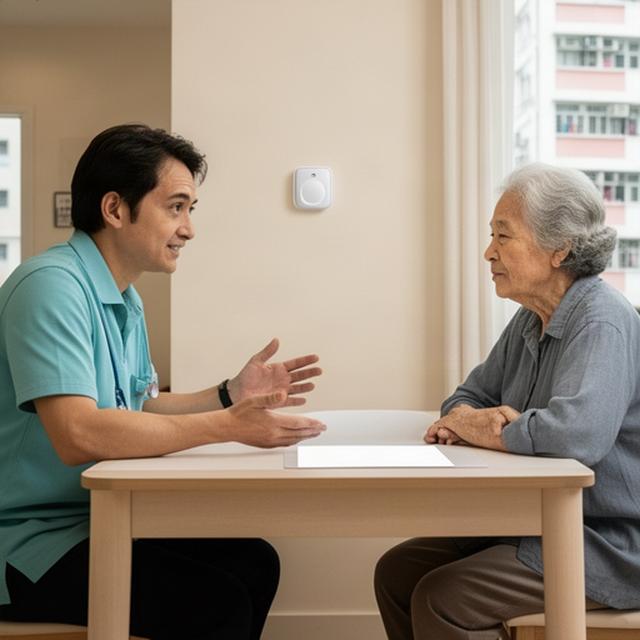
A local assessment can account for room layouts, household preferences and the people who will respond when something changes.
Agree which routine signals matter before choosing any sensing equipment.
Discuss device placement openly. Cameras are deliberately avoided in private spaces.
Name who checks in first and who should be contacted next if they cannot respond.
Where appropriate, include private nurses, home-care providers or family caregivers in the discussion.
Straight answers first
Start with your household
Tell us about the flat, the person who lives there and the concern behind your enquiry. A Singapore-based advisor can help you decide what is worth assessing.